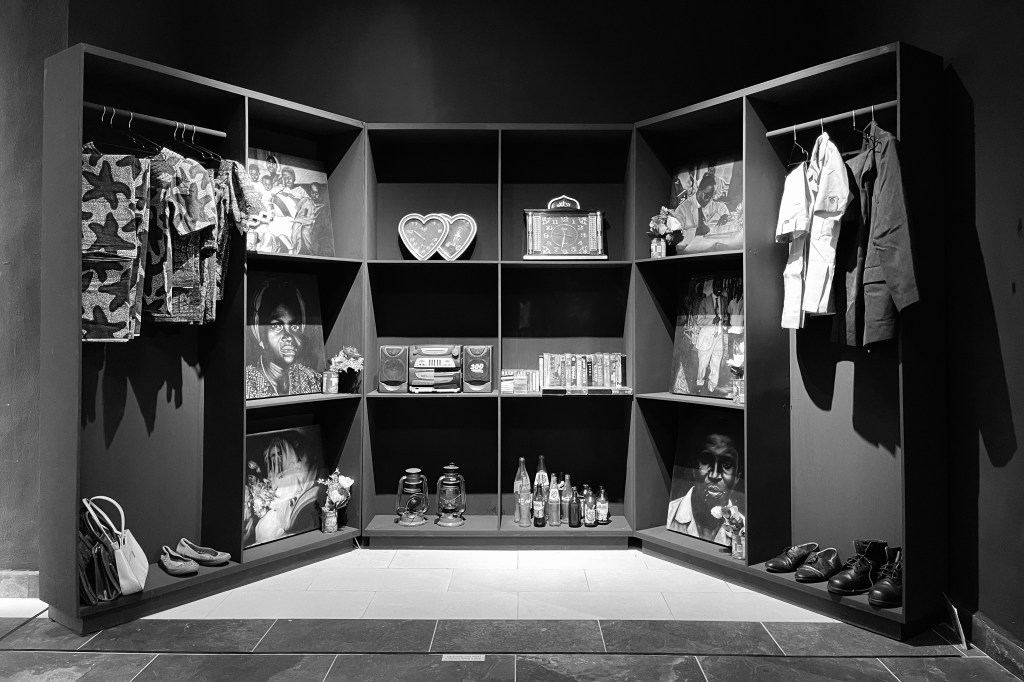
HOME is a solo exhibition by Daniel Arnan Quarshie with Compound House Gallery in Kumasi, May 2023. Earlier in April Quarshie had staged their first solo exhibition, ‘Sympathetic Magic’ at Gallery 1957 in Accra. With recurring themes and display strategies, and opening only a month apart, HOME appears to be a sequel. This exhibition, much like the previous one, presents autobiographical reflections of a home irreversibly transformed by voids created from familial love and loss. A challenge is presented to the audience member who is privy to the story that makes this show so emotionally charged. If one did not know the artist or their story, how differently would they approach the exhibition?
At the entrance, to the left, covering the glass wall from which the doorway is carved, is some wall text. Its early scenographic appearance here emphasises its special role as a mediation tool—to guide the audience’s experience with some background information, a poetic overview and useful tips. This statement which would usually be in the voice of the exhibiting artist or curator, is presented by the curating-artist Robin Beth Riskin. It is curious that Riskin plays neither of those roles (artist or curator, in that usual sense) in this show—Quarshie plays both however. Riskin hybridises the wall text to become something more than simply informational. It performs here as part of an intervention which they have called “curatorial processing”. The text is accompanied by video, sound and QR Codes that lead back to those forms and then some. In the video, images of the artist’s work and process, research and inspiration are layered with sonic montages. In those, Riskin and Quarshie’s voices echo through incoherent interviews, as it were, sporadically overlaid with popular secular music. Riskin asks questions and repeats Quarshie’s answers, occasionally rewording and rephrasing as if suggesting edits to a written text. By augmenting the artist’s voice in this literal sense, what the audience observes is a performative rendition of some sort of a collaboration between a fictionalised artist and a curator. Riskin’s presentation continues to emphasise that those positions could be more nuanced and their roles hybridised. A false binary unravels and reveals itself.
Quarshie draws figurative pictures through archival manipulations in charcoal and presents them on blackened walls, shaped shelves or incomplete prismic structures in this exhibition. The artist builds all their monochromatic pictures, in part, by combining additive applications of charcoal with subtractive erasures that enable illusions of 3-dimensionality to emerge on the otherwise 2-dimensional surface—some on canvas, others on wooden panels. In 2-dimensions, forces of tenebroso can erode the boundaries between figures and their immediate dark backdrops, an irreverence for perspective between the related figures can place them abreast or superimposed without rational proportions, sfumato softens edges to allow figures fade or bleed into others. Quarshie works in these tested techniques only to complicate their known uses. The illusions that appear therefore do not adhere too strictly to the laws that construct them and the picture that is produced is of an otherworldly quality.
In HOME, as in Sympathetic Magic, Quarshie attempts to conjure entryways into the (un)known realms where loved ones pass to, primarily through the picture plane. The works installed on the prismic structures are created as square grid tiles, arranged side by side to complete the picture. Here, the surface area of each square attempts to extend its boundaries by optical means to the next through their adjoining vertexes. However, the physical properties of wood (even when it is concealed by the stretched canvas) that form the framework for these surfaces complicate these attempts and expose the illusion. Obviously, there are thin gaps where the canvases meet, but where they fail to touch, the gaps are more profound—forming conspicuous slits in reality. Paradoxically, those slits become narrow black portals into the domains of death and hope or as Kobena Mercer puts it, “spaces of chthonic darkness”. Perhaps it is here that the artist achieves their initial goal.
If one adopts Mercer’s model of analysing black and white palettes through phenomenological reasoning instead of the representational, one would then ask of Quarshie’s show also, “what does blackness do?” While for Mercer, this is applied to analyse ‘black abstraction’ in the 1950s USA, Quarshie’s work appears to prompt a more personal, almost insular reading. Generally, for a Ghanaian audience, a black overall (I use this word to mean two things: the decision to fill the exhibition space with blackened walls, structures and drapery; and a black on black outfit) instantly signals a period of mourning. It is punctuated by the objects installed in the space. On the shelves with canvases, the artist has installed artificial flowers blooming out of empty beef pâté cans—a brutal reminder of mortality. Again, the artist takes up established tropes, evoking memento mori and the 16th century vanitas genre of still-life painting into an installation, and expanding it by including such 21st century objects as empty Coca-Cola and Malta Guinness bottles, dead clocks, and anachronistic lanterns, cassette players and Ghanaian music—Christian & Gospel songs from the early 2000s which are to some extent becoming outdated today, reserved for funerals. One really strikes a chord. In ‘Wo Ama Me Anwu a Mema Wo Amo’ (2003) by Esther Nyamekye, the protagonist is (ironically, for our reading) grateful for a triumph over death—however relatively short-lived this triumph may be. The vanitas reference reminds one of another song, a hymn that goes, “mato miwetoonii yε ηwεi, jεmεlε awrεho bε jεi, jεmε lε miishεε sɔɔ. Mato miwetoonii yε ηwεi” —a likely response to Matthew 6:19-20.
At this point, the emotional fervency of Quarshie’s subject can no longer be ignored. It is extremely personal and by decidedly being so utterly raw, tends towards a possible universality capable of subverting limiting representationalist readings. Since ‘HOME’ reflects on familial relations, we can compare these two modes of identifying such relations. First, relying on physical resemblance, we may attempt to identify relatives by stereotyping skin colour and other bodily features to confirm our assumptions. Conversely, if we consider genotype via DNA sampling, we may find striking similarities between bodies that do not physically appear to be related. Other non-physical markers could be social, economic, historical, philosophical, technological, etc. It would be an injustice to contrive his pictures into a narrow reading of racialized identities. Likewise, the complexities of works of art should not be written off—and neither should their contradictions. A generalised reading for a generalised Ghanaian audience leads us to a valid phenomenological experience of death and mourning when we encounter HOME, but those intentions (in this case, a social idiosyncrasy) will not work for all and sundry. Thus the readings would vary.
Matthew 6:19-20 reads:
19 Lay not up for yourselves treasures upon earth, where moth and rust doth corrupt, and where thieves break through and steal:
20 But lay up for yourselves treasures in heaven, where neither moth nor rust doth corrupt, and where thieves do not break through nor steal…
This cautionary advice, aside its religious disposition, is quite fitting for discussing certain art exhibition spaces—actually it’s perfect. A gallery space modelled after the ‘white cube’ ideology assumes an eternal, neutral state that can be likened to these notions of heaven. In it, art is finished and does not change, and it is not interfered with by elements outside of itself. If the aim is to perform sympathetic magic, to hold on to loved ones who have passed through their image, then the stable ‘white cube’ seems an obvious choice. Instead, HOME is counterintuitive, but to what end?
The exhibition does this beyond the fact of its blackened walls. When the spectator moves their body around the works on wooden panels, light bounces off their surfaces and produces glares that shift with their movements. Quarshie’s fixative curing process involves layering the drawn surface with dilute white glue. Where on the canvas works, absorbent linens fuse with the solution, the wood doesn’t. The solution forms a reflective film on its surface. This contrast reminds one of cooking with charcoal in a Ghanaian home on a coal pot. There are smooth, soft, matte charcoal that are easy to draw on walls and upset parents with, and there are the harder, sharper, glossy ones that are good for producing kpεtε-kplε! Additionally, the physical properties of multiple lighting casts several shadows of the false flowers on the shelves, onto the surface of the drawings they share room with. It creates grades of soft ghostly shapes similar to Quarshie’s drawn ones, augmenting the artist’s intentions to bridge realms. It continues with the gallery itself.
Compound House positions itself as a quasi-mobile gallery (or perhaps an entirely floating one with no interests in permanent housing. Time will tell) that currently operates in temporary spaces. This show is staged in a showroom on the first floor of the Jubilee Mall on KNUST Campus, Kumasi. It has two glass walls—one faces north, outward and overlooks Commercial Link and the other inwards revealing a hallway and an electrical appliance store opposite it. This exhibition space is porous. Over the north facing side, drapes of a thin black curtain veils the wall. Its blackness attempts to absorb the outside light but its thinness creates a translucency that affords filtered glimpses of the outside world to seep through. What appears is a shadowy rendition of a known world or rather yet another portal into an unknown realm. The second glass wall receives no such treatment as the first and it contributes to this porosity more obviously—by revealing what is outside to what is inside and vice versa. Another contributing element is the few QR Codes distributed across the space, which lead the spectator out of the space into the virtual and enable them to carry along with them bits of the exhibition on their handheld devices even after they have left—provided they have such devices, with internet connection and the required economical means to access it. These occurrences are especially inconsistent with the ‘white cube’ space.
Quarshie’s pictorial compositions and display strategies, Riskin’s intervention, the physical properties of light and the architectural considerations suggest that perhaps in HOME, the crux of the matter was never to seek ways in which to hold on as it was for ‘Sympathetic Magic’, but rather an acceptance of change and a letting-go. A fare-thee-well.
-Abbey IT-A
Supplemented with thoughts from Godelive Kasangati Kabena, Edward Prah
 Abbey IT-A
Leave a comment